
What Is an Auto-Draw Sensor in a Vape?
Summary: An auto-draw sensor detects changes in airflow or air pressure when someone draws through a vape’s mouthpiece. It signals the device’s control circuit to activate the heating element without pressing a firing button. Sensor design varies, and condensation, blocked air passages or electronic faults can affect operation.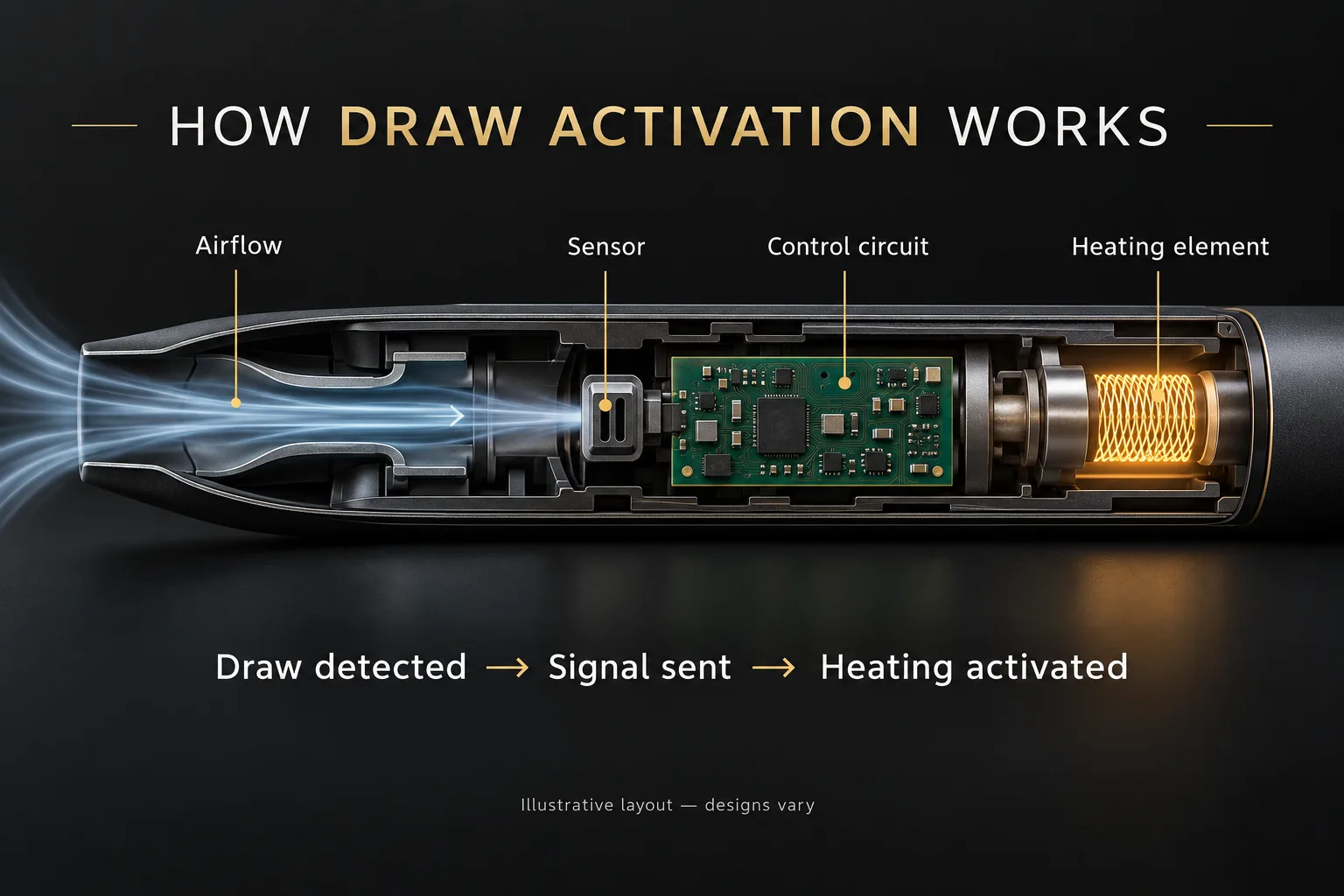
What Does an Auto-Draw Sensor Do?
An auto-draw sensor, sometimes called a draw-activation or airflow sensor, acts as the trigger for a vape’s heating system.
Instead of relying on a firing button, the device detects a draw through the mouthpiece and uses that signal to activate the coil. Manufacturers describe this as draw-activated or automatic draw operation. The exact sensing mechanism depends on the device. Aspire
The sensor and coil perform different jobs: the sensor detects the draw, while the coil heats the e-liquid.
How Does an Auto-Draw Vape Work?
In a typical draw-activated device, the process follows four stages:
- A draw changes airflow or pressure inside the device.
- The sensor detects that change and sends an electrical signal.
- The control circuit activates the heating element, subject to the device’s operating conditions and protection features.
- Heating stops when the draw ends, or when a programmed safety limit is reached.
Protection features vary between models. Some devices include an activation time limit or temperature protection, but these features should be checked in the relevant manual rather than assumed. Aspire
Auto-Draw vs Button Activation: What Is the Difference?
The main difference is how the heating cycle starts.
Some devices support both methods. For example, manufacturer documentation may identify separate automatic, button and combined activation modes. A device having a button does not necessarily mean it lacks an auto-draw sensor. Aspire
Is the Auto-Draw Sensor the Same as Airflow Control?
No. These terms describe different functions.
The auto-draw sensor detects a draw. Airflow control changes the amount of air passing through the device.
An adjustable airflow opening can affect draw resistance, but it is not itself the electronic sensor. Manufacturers may list draw activation and adjustable airflow as separate specifications. INNOKIN®
Likewise, terms such as mesh coil, dual mesh and coil resistance describe the heating system rather than the activation sensor.
Can Condensation Affect an Auto-Draw Sensor?
Yes, depending on the design and where moisture collects.
Condensation or leaked e-liquid near a sensor or its air passage may interfere with operation. Aspire’s support guidance for its Breeze device specifically warns against allowing e-liquid or condensation to reach the automatic activation component.
That guidance is model-specific, but it illustrates why moisture around an activation system should not be ignored. Cleaning methods should always follow the device’s own instructions. Aspire
Does Failure to Activate Mean the Sensor Is Broken?
Not necessarily. A device failing to activate does not, by itself, identify which component has failed.
Possible explanations include a depleted battery, a locked or switched-off device, an obstructed air passage, a connection problem or a fault in the sensor or control circuit. These are possibilities to assess against the manufacturer’s manual, rather than a diagnosis.
Avoid repeatedly drawing harder to force activation. Do not insert pins into air holes, introduce cleaning liquid into the electronics or dismantle a sealed device.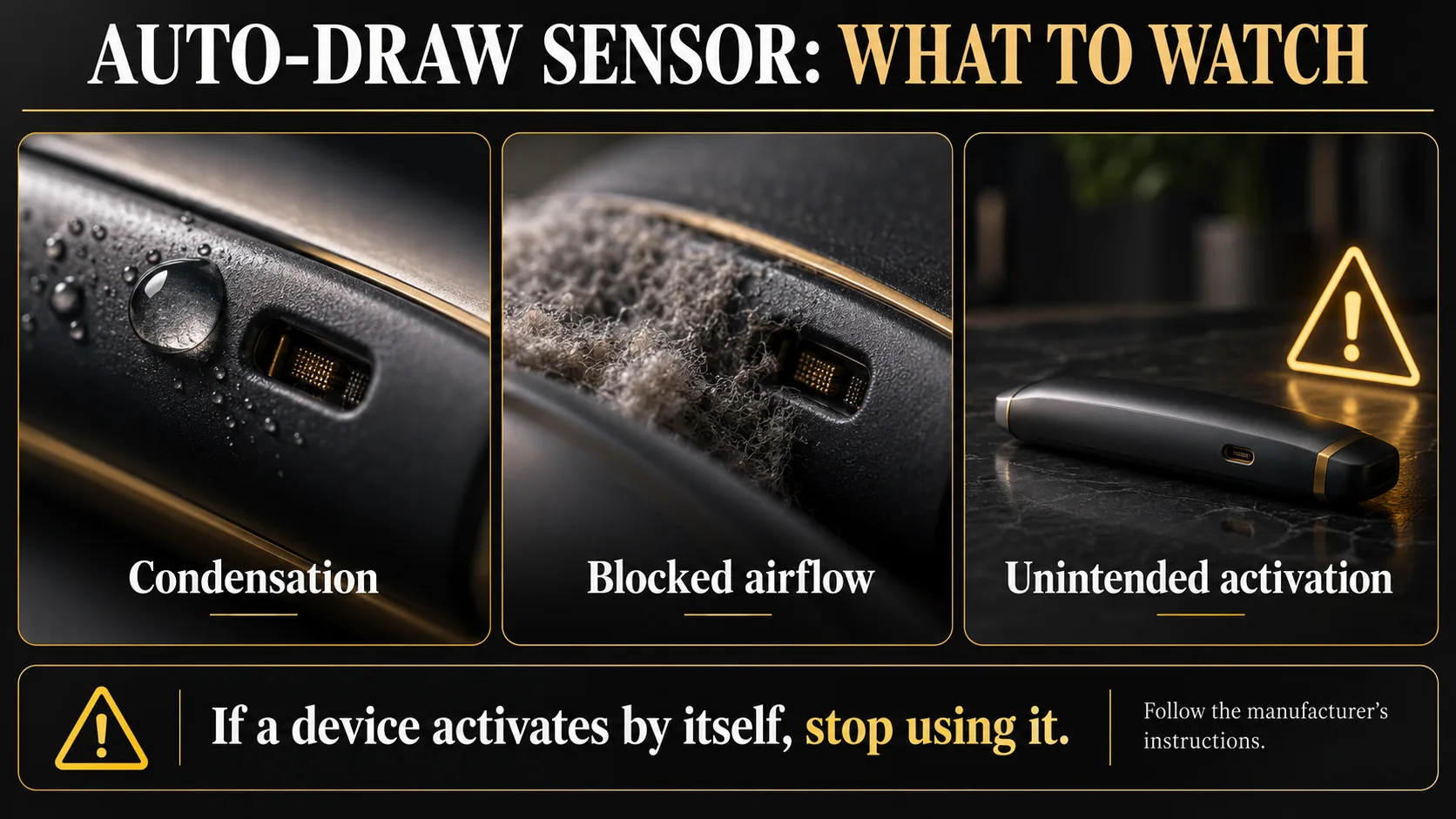
What If a Vape Activates by Itself?
Unintended activation is a fault that requires stopping use. Warning signs include heating, continued hissing or an activation light remaining on when no one is drawing.
If this happens:
- Switch the device off if it has an accessible power control and this can be done safely.
- Stop charging it.
- Keep it away from combustible materials if safe to do so.
- Follow the manufacturer’s fault guidance and seek support.
Do not blow into the mouthpiece to try to reset the sensor. Aspire warns that this can trigger unintended activation on certain devices. A hot, swollen, smoking or damaged device should not be handled or dismantled. Aspire
Frequently Asked Questions
Does every vape have an auto-draw sensor?
No. Devices may use button activation, draw activation or a combination of both. Check the model’s manual to confirm its activation method. Aspire
Does an auto-draw sensor measure e-liquid levels?
The draw sensor’s role is to detect activation. A liquid-level indicator is a separate function; its presence and operation depend on the device.
Is auto-draw the same as automatic power adjustment?
No. Draw activation determines when heating starts. Power regulation determines how electrical power is supplied to the coil. The term “auto-draw” alone does not establish that a device adjusts its output automatically.
Can an auto-draw sensor be replaced?
This depends on the product’s construction and service arrangements. Do not assume it is a user-replaceable part, particularly in sealed devices. Follow the manufacturer’s instructions rather than attempting an internal repair.