
Have you ever noticed your IGET vape suddenly stops producing vapour, even though the device appears to have power remaining?
This is one of the common technical problems that can occur with disposable electronic vaping devices. Whether you're researching the IGET ONE 12000, IGET BAR PRO 10000 or another IGET model, understanding the possible causes can help you recognise device faults and make safer decisions.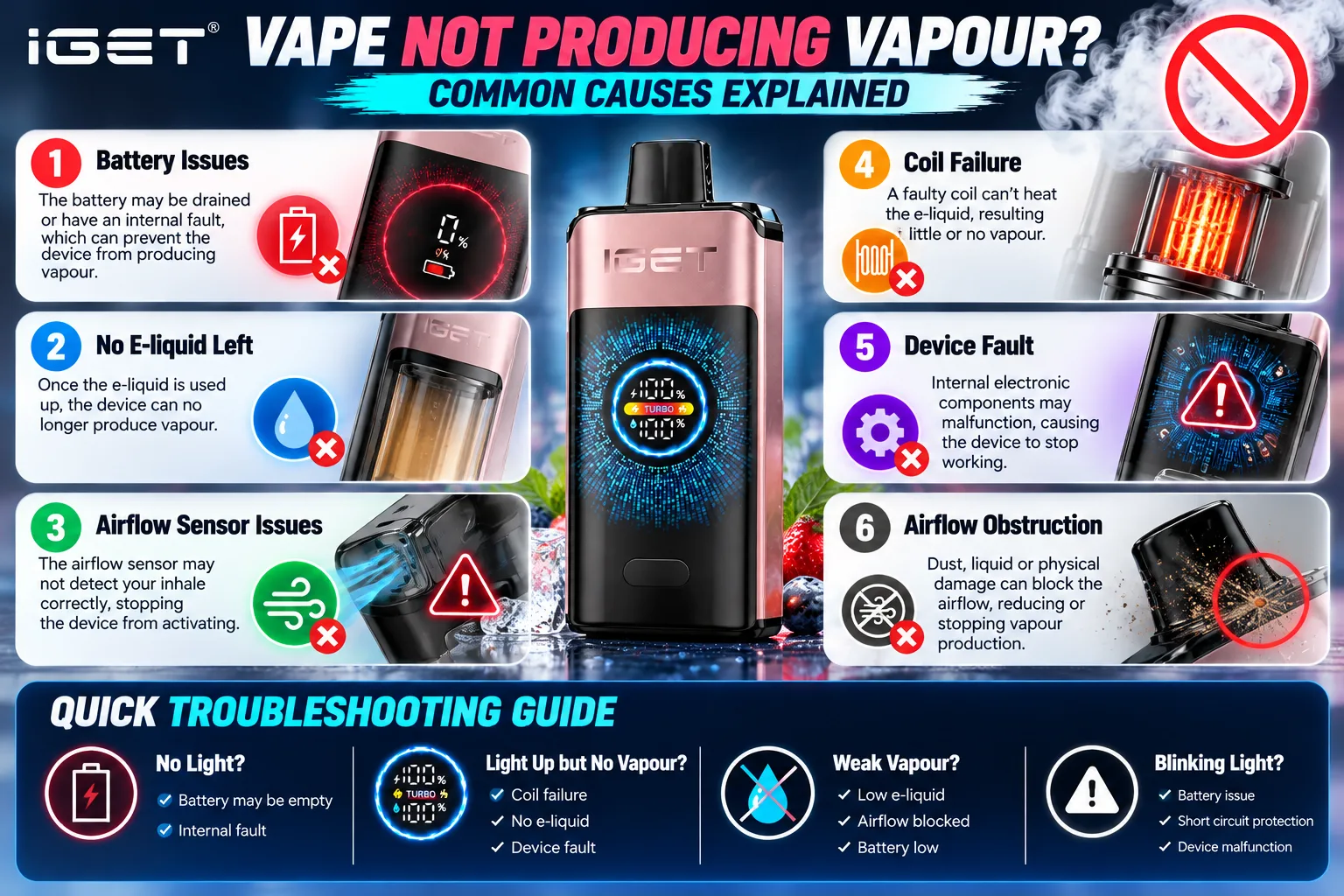
Some devices stop producing vapour gradually, while others may stop working without warning. In certain cases, the indicator light still operates, but no vapour is produced.
So, why is your IGET vape not producing vapour?
In this guide, we'll explore seven possible causes, explain the symptoms associated with each issue and discuss important safety considerations for Australian readers.
1. Battery Failure or Insufficient Power
One of the most common explanations for an IGET vape not working is a battery-related problem.
Electronic vaping devices rely on internal batteries to provide electrical power to their heating elements. When the battery cannot deliver sufficient power, the device may stop generating aerosol.
Common symptoms of battery problems include:
No response when the device is activated.
The indicator light does not illuminate.
The indicator flashes but no vapour appears.
The device works intermittently before stopping completely.
Vapour production gradually becomes weaker.
Some IGET models are designed with different battery capacities and electrical configurations.
For example, the IGET ONE 12000 is commonly advertised with a 2700mAh battery, although specifications should always be checked against reliable manufacturer documentation.
Battery capacity alone does not guarantee how long a device will function.
Safety note: Do not attempt to open, modify, externally charge or repair a disposable vape unless the manufacturer explicitly provides an approved procedure.
2. The E-Liquid Has Been Depleted
Another possible reason an IGET vape stops producing vapour is that the available e-liquid has been consumed.
Disposable vaping devices contain a limited quantity of liquid. When the liquid supply becomes insufficient, the heating element may no longer produce aerosol normally.
Possible signs include:
Gradually decreasing vapour production.
A dry or burnt taste.
Changes in flavour intensity.
Vapour production stopping after prolonged use.
The IGET ONE 12000 is commonly listed with an 18mL e-liquid capacity, but published specifications can vary between product versions and should be independently verified.
A device may also stop producing vapour before its advertised puff count is reached.
This does not necessarily indicate a manufacturing defect, because actual usage depends on puff duration, device operation and other factors.
If a device produces a dry or burnt taste, discontinue use.
3. Airflow Sensor Malfunction
Many disposable IGET models use an automatic draw-activation system.
Instead of requiring a separate power button, the device detects changes in airflow when the user inhales.
If the airflow sensor fails to detect the pressure change correctly, the device may not activate.
Possible symptoms include:
No response during activation.
Intermittent operation.
Indicator lights behaving unexpectedly.
The device stopping without an obvious reason.
Airflow sensor problems may be associated with internal condensation, electronic faults, physical damage or manufacturing defects.
Because the sensor is located inside the device, attempting to repair it may require unsafe disassembly.
For this reason, internal sensor repairs should not be attempted by consumers.
4. Heating Coil or Atomiser Failure
The heating coil is an essential component of an electronic vaping device.
Its purpose is to convert electrical energy into heat, allowing the e-liquid to form an aerosol.
Some IGET models use mesh-coil technology, although the exact heating-element design varies by product.
A faulty heating element may prevent normal aerosol production.
Common signs of a possible coil problem include:
The device indicator illuminates, but no vapour is produced.
Vapour production suddenly stops.
The device produces an unusual burnt taste.
Performance becomes inconsistent.
It is important to understand that an illuminated indicator does not necessarily mean the heating coil is operating correctly.
If an internal coil fault is suspected, discontinue use and seek appropriate product support.
5. Blocked Airflow or Mouthpiece
Airflow obstruction can also affect vapour production.
External openings may become blocked by dust, packaging materials or other debris.
Physical damage may also affect internal airflow pathways.
Possible warning signs include:
Restricted airflow.
Unusual resistance when drawing.
Little or no vapour.
Inconsistent activation.
A visual inspection may help identify obvious external packaging or damage.
However, consumers should not insert sharp objects into the mouthpiece or attempt to force air through the device.
Doing so may damage internal components or create additional safety risks.
6. Internal Electronic or Manufacturing Defects
Sometimes an IGET vape stops working because of a fault in its internal electronic components.
Electronic vaping devices generally contain a control circuit responsible for managing power delivery and activation.
If the circuit malfunctions, the device may not operate normally.
Potential symptoms include:
Sudden failure without warning.
Unusual indicator behaviour.
Inconsistent activation.
No vapour despite an apparently functioning indicator.
Unexpected overheating.
Manufacturing defects can occur in electronic products, including devices that have never been used.
If a device becomes unusually hot, emits an abnormal smell, leaks or shows signs of battery damage, stop using it immediately.
Do not attempt to disassemble or repair the device.
7. Counterfeit or Poor-Quality IGET Devices
Product authenticity is another consideration when investigating an IGET vape that does not function as expected.
Counterfeit electronic devices may contain components that differ from the manufacturer's intended specifications.
These differences may affect battery performance, electrical reliability and overall product safety.
Potential warning signs include:
Incorrect or inconsistent brand spelling.
Poor-quality packaging.
Unusual printing or labelling.
Product specifications that differ from reliable manufacturer information.
Suspicious verification websites.
Visible manufacturing defects.
However, a malfunction does not automatically mean a device is counterfeit.
Genuine electronic devices can also develop faults.
Consumers should avoid relying exclusively on QR codes or packaging appearance when evaluating product authenticity.
IGET Vape Troubleshooting: Common Symptoms and Possible Causes
The following table provides a general overview of symptoms associated with disposable vape malfunctions.
IGET Vape ProblemPossible CauseIGET vape not producing vapourBattery, coil or e-liquid issueIGET vape lights up but no vapourHeating element or internal circuit faultIGET vape not hittingAirflow sensor or power failureIGET vape blinkingBattery or electronic fault; indicator meanings varyIGET vape tastes burntInsufficient e-liquid reaching the coilIGET vape suddenly stopped workingBattery, sensor or manufacturing defectIGET vape producing weak vapourReduced liquid supply or inconsistent powerThese symptoms are not sufficient to establish a definitive diagnosis.
If a device repeatedly fails to operate normally, the safest option is to discontinue use rather than attempting internal repairs.
Why Does My IGET Vape Light Up but Produce No Vapour?
One frequently discussed problem is an IGET vape that lights up but produces no vapour.
This situation may occur because the indicator circuit is functioning while another essential component has failed.
Possible explanations include:
A faulty heating coil.
Insufficient e-liquid.
An internal electrical connection problem.
A control-circuit malfunction.
A battery that cannot supply adequate power under load.
The indicator light alone cannot confirm whether the heating element is operating correctly.
Repeatedly activating a malfunctioning device is not recommended.
Why Does My IGET Vape Stop Working Before the Advertised Puff Count?
Some consumers expect a disposable vape to deliver exactly the number of puffs stated on its packaging.
However, advertised puff counts are estimates rather than guaranteed usage totals.
Actual device lifespan can vary depending on several factors.
Puff duration: Longer inhalations generally require the heating element to remain active for more time.
Battery performance: Battery output can change as the available energy decreases.
E-liquid consumption: Liquid consumption may vary depending on operating conditions.
Device settings: Models offering different operating modes may consume power and liquid at different rates.
Manufacturing variation: Individual devices may perform differently even when they share the same model designation.
For example, the IGET ONE 12000 is marketed with Regular and Turbo operating modes. Different power settings can affect the rate of battery and liquid consumption.
The advertised 12,000-puff figure should therefore not be treated as a guarantee of exactly 12,000 inhalations.
IGET Vape Safety and Regulations in Australia
Australia has introduced strict regulations governing the importation, supply, advertising and sale of vaping products.
Under Australia's therapeutic vaping framework, lawful retail supply is restricted to pharmacies operating within the applicable regulatory requirements.
Disposable vaping products cannot be lawfully sold through ordinary convenience stores, tobacconists or general vape retail websites.
Australian consumers should also be aware that nicotine and non-nicotine vaping products are subject to regulatory controls.
For current information, refer to the Australian Therapeutic Goods Administration (TGA).