Introduction
IGET has appeared in Australian media coverage of the vaping market, particularly in discussions about product labelling, independent testing, illegal supply and Australia's changing vaping regulations.
For Australian readers searching for IGET vape news, it is important to distinguish between verified regulatory information, findings from individual product tests and allegations reported by the media.
Recent coverage has also raised broader questions about how accurately vaping products are labelled and whether the contents of individual products match their stated specifications.
This article examines the main issues covered in public reporting and explains where readers can find reliable information about Australia's vaping laws.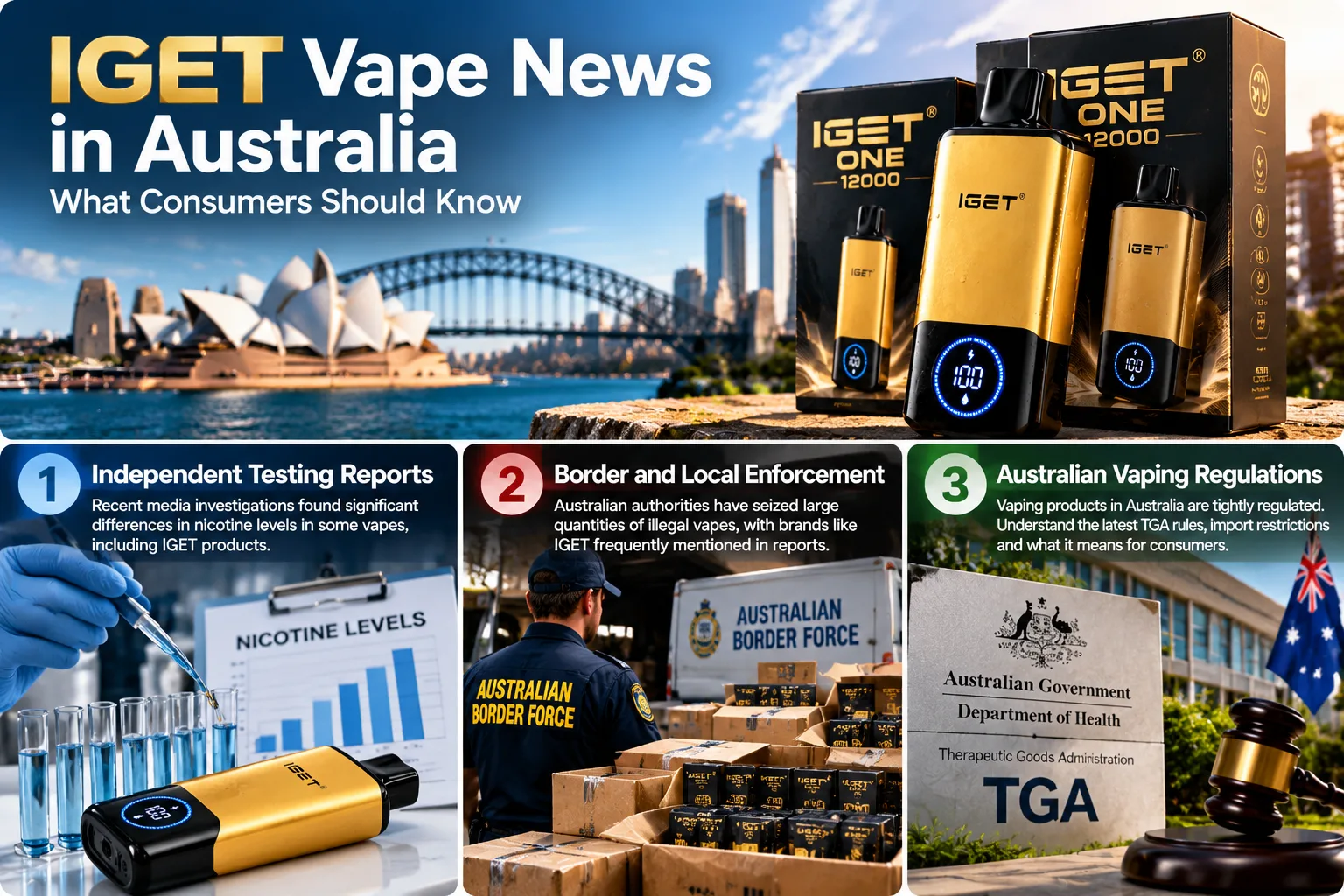
1. Recent IGET News: Independent Testing Raises Labelling Questions
On 18 July 2026, The Daily Telegraph published an investigation into nicotine levels in selected vaping products available in Australia's illicit market.
According to the report, independent testing examined six black-market vape products, including samples associated with IGET and ALIBARBAR. The investigation reported substantial differences in measured nicotine concentrations across the products tested.
The report also raised concerns about ingredient disclosure, flavouring chemicals and the consistency of product labelling.
These findings are relevant to broader discussions about product quality and consumer awareness. However, the results must be interpreted carefully.
Testing a limited selection of products does not establish the composition of every product sold under a particular brand. It also does not prove that every product from the same manufacturer or model has identical characteristics.
Readers should distinguish between the findings for the specific samples tested and conclusions that would require more extensive testing.
Source: The Daily Telegraph — Vape investigation and new independent testing
2. Why Product Labelling and Verification Matter
One issue highlighted in public reporting is the difficulty of determining exactly what a vaping product contains from its packaging alone.
Product names, flavour descriptions and stated nicotine concentrations provide information, but they are not substitutes for reliable testing and appropriate regulatory documentation.
When assessing information about a particular product, readers should consider several questions:
Does the packaging clearly identify the product and its manufacturer?
Are the stated ingredients and nicotine concentration supported by reliable documentation?
Is there independent testing relevant to the specific product or batch?
Does the available information establish the product's regulatory status?
Are claims about authenticity supported by evidence rather than appearance alone?
A familiar brand name or a matching product photograph cannot independently establish a product's composition, safety or legal status.
Similarly, a report about a particular sample should not automatically be treated as proof that every product bearing the same brand name has the same characteristics.
3. IGET and Australia's Vaping Regulations
Australia introduced major changes to vaping regulation in 2024, followed by strengthened product standards for therapeutic vaping goods from 1 July 2025.
Under the current framework, vaping goods are subject to restrictions covering importation, manufacture, supply, possession and advertising. The applicable requirements depend on the product and the circumstances.
The Australian Government states that vaping products can only be supplied through pharmacies for therapeutic purposes under the relevant framework. Single-use disposable vapes cannot be purchased from pharmacies, and ordinary retail businesses cannot legally sell vaping products.
The Therapeutic Goods Administration (TGA) also introduced stricter requirements for therapeutic vaping products, covering permitted ingredients, packaging, labelling, device design and technical standards.
These requirements are important when interpreting news about IGET or any other vaping brand in Australia.
A product appearing in an online catalogue, retail listing or media report does not establish that it is authorised for supply in Australia.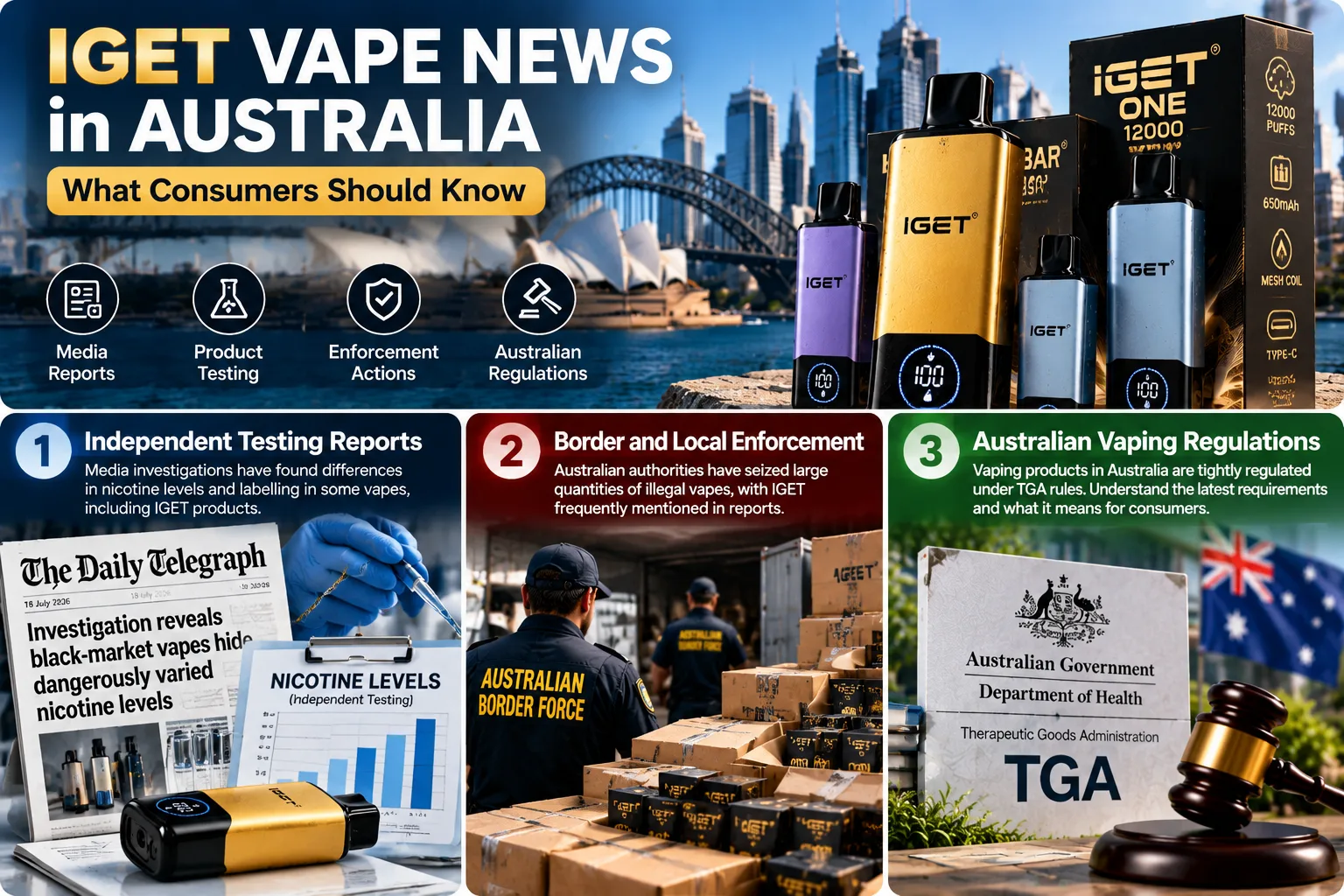
Official source: Australian Government — About vaping and e-cigarettes
Additional guidance: TGA — New standards for nicotine vaping products from July 2025
4. What Did Earlier Media Coverage Report About IGET?
On 16 September 2025, The Australian published an investigation concerning IGET, ALIBARBAR and the supply of disposable vaping products to Australian consumers.
The report examined online sales, bulk supply and compliance with Australia's restrictions on vaping products.
These were matters raised in investigative reporting about the broader market. They should be distinguished from a final determination by a court or regulator concerning a particular company or individual.
For readers researching IGET, the important questions are whether the claims are supported by verifiable evidence, whether the relevant parties have responded, and whether an official regulatory finding has been published.
Media investigations can provide useful leads, but readers should consult primary documents and official announcements wherever possible.
5. How to Follow Reliable IGET News in Australia
For readers following developments involving IGET, several sources can help separate confirmed information from speculation.
Therapeutic Goods Administration (TGA)
The TGA publishes information about therapeutic vaping standards, product compliance, enforcement activity and regulatory changes.
Australian Government Department of Health
The Department of Health provides information about vaping legislation, public health concerns and available support for people who want to stop vaping.
Established Australian news organisations
News outlets may publish investigations, interviews and independent testing reports. When reading these stories, check the publication date, the scope of any testing, the evidence presented and whether the findings have been independently confirmed.
Product-specific documentation
Where a report concerns a particular model or batch, the relevant product documentation and testing records are more useful than general statements about a brand.
Using these sources together provides a clearer picture than relying on social media posts or unverified online claims alone.
6. What Should Consumers Take Away From These Reports?
Recent coverage of IGET and the wider Australian vaping market highlights three important considerations.
First, product labelling should not be treated as independent proof of actual contents. Where reliable testing is available, its scope and findings should be examined carefully.
Second, reports about individual products should not automatically be generalised to every product carrying the same brand name.
Third, product identity and legal supply are separate questions. Even if a product can be identified correctly, that does not establish that its importation or supply is lawful under Australian regulations.
Consumers should use official government information when checking current legal requirements and should avoid relying on price, packaging or brand recognition as proof of safety or authenticity.